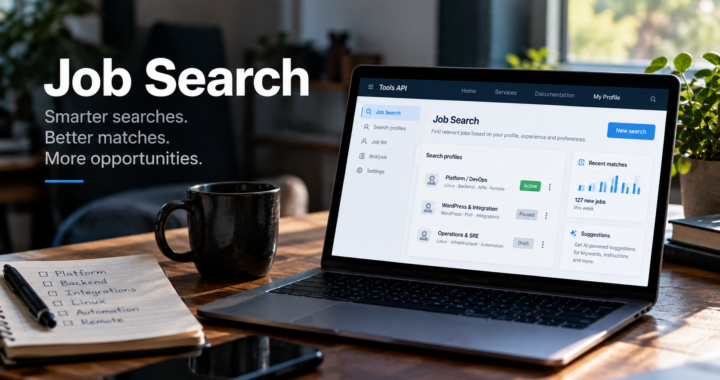
Job Search has continued to evolve, but the latest work has also exposed an old assumption that no longer belongs in the service.
One of the AI-assisted configuration functions was still checking whether the user had been granted a separate, generic OpenAI permission before it would run. That does not fit how Job Search is supposed to work. If a user has access to Job Search, the AI features belonging to Job Search should be handled by the service itself rather than requiring another unrelated permission on the account.
That legacy check has now been removed from the Job Search AI helpers.
This applies to functionality such as:
- AI-assisted job-search instruction suggestions
- suggested profile names
- negative keyword suggestions
- CV analysis and related professional-background helpers
The important part is that Job Search can now treat these features as part of Job Search itself instead of leaking an internal OpenAI access model into the user experience.
Better instructions, not just more keywords
The next step is less about adding another search field and more about making the search profile itself smarter.
A Job Search profile already contains quite a lot of information: keywords, locations, exclusions, relevance rules, instructions, previous searches and, where available, CV and application material.
The longer-term goal is to make better use of that information.
Instead of only asking the user to manually write more instructions, Tools should be able to analyse the existing profile and start a useful conversation around it.
For example:
What would you like the search to focus on more?
Are there types of jobs you keep seeing that are not useful?
Are we missing roles that would make sense based on your experience?
Should the search be broader in some areas and stricter in others?
That would make Job Search less of a static configuration form and more of an assistant that can help refine the search over time.
Learning from previous searches
Another part of that idea is to analyse what the searches have actually produced.
If a profile repeatedly returns jobs that are dismissed, poorly matched or clearly outside the user’s intentions, that should be useful information.
Likewise, if relevant jobs repeatedly appear under titles or technologies that were not originally included in the profile, Tools should be able to point that out.
The aim is not to silently rewrite someone’s search profile.
Instead, Job Search should be able to explain what it sees and suggest improvements that the user can review and approve.
That could eventually mean suggestions such as:
- broaden a role family that appears to produce good matches
- add a missing synonym or adjacent job title
- tighten an exclusion that repeatedly produces noise
- reconsider a geographical restriction
- distinguish between a hard requirement and something that is merely preferred
- identify skills in the CV that are not currently reflected in the search profile
Much better AI-generated instructions
The instruction field is also becoming increasingly important.
Short keyword-style AI suggestions are not enough for more advanced profiles. A useful instruction should be able to describe priorities, trade-offs, geography, role families, technical interests, exclusions and acceptable adjacent opportunities in a way that the search engine can actually work with.
The intention is therefore to make AI-generated instruction suggestions longer, more detailed and more useful as complete search strategies.
Rather than producing three slightly different versions of the same sentence, the suggestions should be able to represent genuinely different approaches, for example:
- a focused strategy based closely on the current profile
- a broader strategy that includes realistic adjacent roles
- an exploratory strategy that looks for opportunities the current configuration may be missing
The user’s own CV and other saved Job Search material can also become important evidence here, so the system can suggest broader searches without inventing experience that is not actually there.
Instruction history and undo
As the instructions become more advanced, simply overwriting the old version is not good enough.
A planned improvement is therefore to keep a history of instruction changes.
That would make it possible to see how a search profile has evolved, compare an older version with the current one and restore a previous version if a change turns out to make the search worse.
This is particularly important if Tools starts helping users refine their profiles over a longer period. Improvements should be reversible.
From configuration to ongoing refinement
The broader vision is that Job Search should not stop being useful once the initial profile has been created.
Creating the profile should only be the beginning.
Over time, Tools should be able to use the profile, previous searches and the user’s own feedback to help answer questions such as:
- What are we missing?
- What are we searching too narrowly for?
- What keeps generating bad matches?
- Which parts of the profile are actually working?
- Are there realistic roles that the current search never considers?
- Has the user’s focus changed since the profile was first created?
The user should remain in control of every meaningful change, but Tools can do a much better job of helping them understand and improve the search.
That is the direction I want Job Search to move in next: not simply more automated searching, but a search profile that can be reviewed, challenged, refined and improved together with the person using it.